
We’ve all seen that guy at the local Cars & Coffee. He’s got his hood popped, a custom laminated spec board propped against the bumper, and he’s telling anyone within earshot that his truck is "one of only 342 built on a rainy Tuesday in April with this exact cigarette lighter option."
Hey, no shade intended. We love the passion. But when it comes to the legendary Chevrolet C10, chasing true, numbers-matching "rarity" is a bit like hunting for Bigfoot.
I recently fell down a rabbit hole researching Chevy C10 production numbers, and the sheer volume of these trucks that rolled out of Detroit is mind-blowing. If you're a C10 owner, the numbers tell a pretty cool story about why these trucks own the hot rod scene today.
The Action Line Era (1967-1972)
Before 1967, trucks were mostly built for farmers, contractors, and plumbers. But with the second-generation "Action Line," Chevy realized people wanted to drive trucks everyday.
The assembly lines basically didn’t stop moving for six straight years. If you think your Action Line C10 is a rare gem, consider this: the factory never cranked out fewer than 290,000 of these trucks a year.
- 1967 and 1971: These are actually the lowest production years for this generation but "low" is a relative term. They still built hundreds of thousands of them.
- 1969: This was the absolute peak of the generation with GM pushing over 400,000 trucks out the door.
The Square Body Era (1973-1987)
If you thought the Action Line numbers were big, the third-generation "Square Body" era went completely off the charts. GM built this platform for 15 years, and it is estimated that over 10 million of these trucks were manufactured. In fact, right out of the gate in 1973, they sold more than a million units in the first year alone.
Why "Common" is a Beautiful Thing for Hot Rodders
So, what’s the point of all these numbers? It means your C10 isn't a museum piece—and that is the best news possible for a hot rod enthusiast.
Because GM built millions of them, two incredible things happened:
- They are everywhere. You can still find them in barns, fields, and classifieds without taking out a second mortgage.
- The aftermarket support is legendary. Since there are millions of C10s still hitting the asphalt, companies love making cool parts for them.
You don't have to scrounge swap meets for rusty, obsolete components. Want to drop a modern LS or LT engine under the hood? Easy. Want to upgrade the suspension so it handles like a sports car? Done.
Keep your Cool While You Custom Build
The only real downside to a truck engineered 40 or 50 years ago? The creature comforts leave a lot to be desired—especially the air conditioning.
If you are currently working on a C10 project, doing an engine swap, or installing a modern serpentine kit, dealing with that old factory AC system can turn into a serious project. Aluminum fittings that have been fused together since the Carter administration love to snap, and those old 40+ year-old evaporators are usually full of sludge.
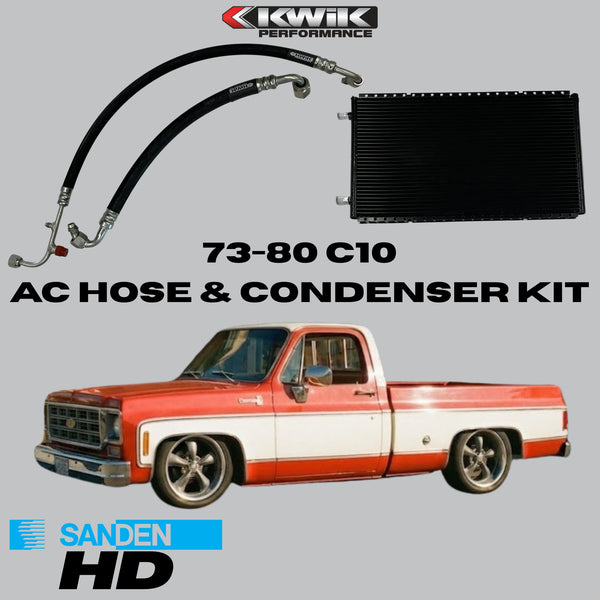
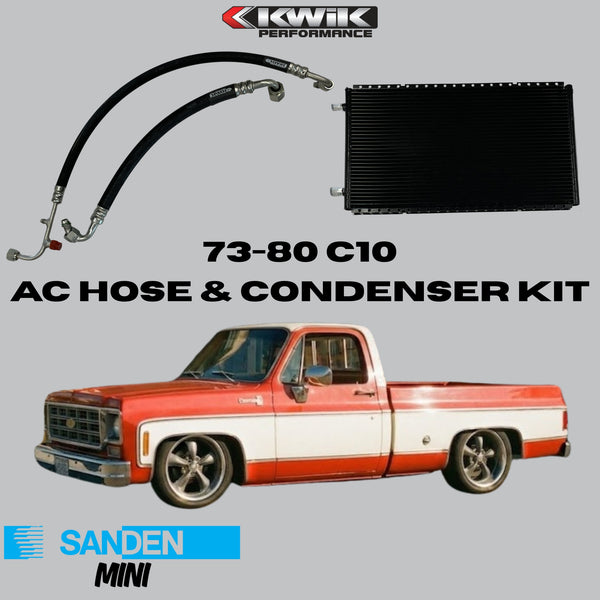
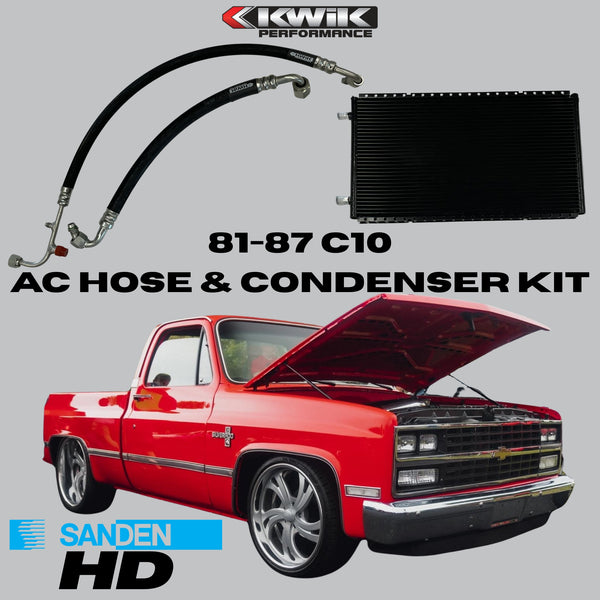
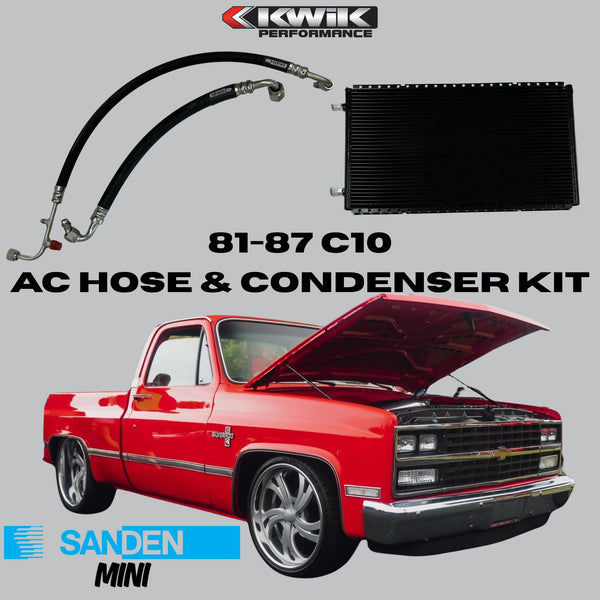
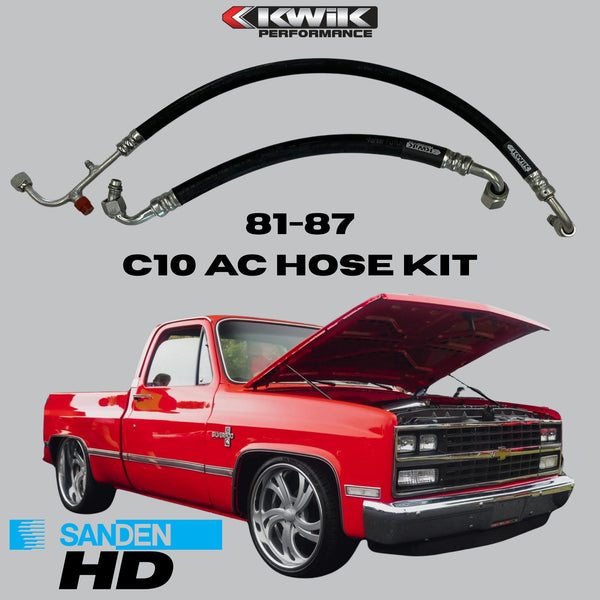
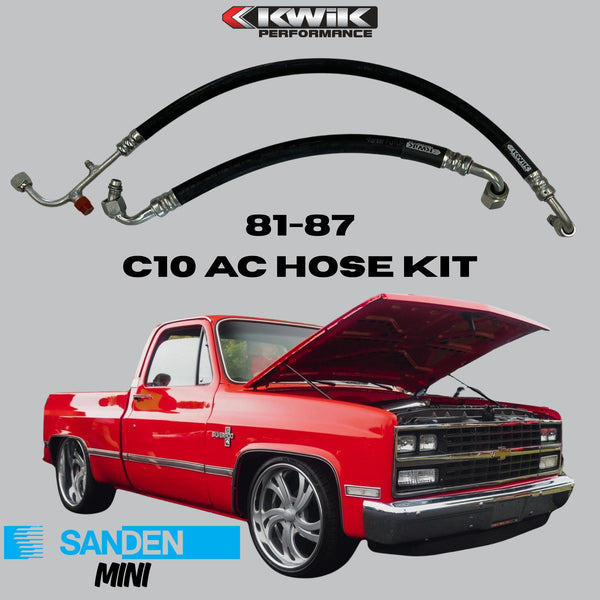
When you get to that stage of the build, we’ve got your back right here at Kwik Performance. Whether you just need a specialized C10 AC Hose Kit to connect a modern Sanden compressor to your factory setup, or you want to shave that ugly factory evaporator box off the firewall entirely and upgrade to a complete, modern Vintage Air Sure-Fit system, we can help you get sorted out.
Our own 1981 C10 test mule is an example of how many variations GM made and how many options you and we have to create a “cool” classic. Our Square Body was originally a “stripper”, a bare bones, low-option truck. It was a three-on-the-tree, 250 cubic inch six cylinder, AC delete. Yet, it wasn’t the typical long-bed work truck, instead, it was a two-tone short bed. See the AI-generated photo below for what it might have looked like when new, albeit lowered:

Like most hot-rodders, our plans keep changing for how to finish this truck but here’s what we’re thinking today. We’re using a 4.8L LS truck engine that we somehow got in a trade. It came without an intake, ECU or wiring harness. To keep things simple, we’ve decided to slap on a carb and a Daytona Sensor ignition box. No need for a high-pressure fuel system or high-dollar ECU and harness. We also ended up with a strip-ready Turbo 350 transmission. No, we don’t plan any strip action but hey, we have it so let’s use it. Once again, simple.
Since the factory heater system is in good condition, we’ve also decided to not rip all that out for a Vintage Air SureFit system but instead, just add a Mark IV under-dash AC unit. I like the add-on vibe (my first AC system was an under-dash unit). And it’s in keeping with the simple theme we have going. We’ll use a Vintage Air condenser and a Sanden Mini compressor on one of our Kwik Performance brackets.
We bought the truck as a partially-completed roller. New rockers and cab corners have been welded but not finished. Doors have been swapped, new front fenders, both outer and inner, and one new bed side were already in place. We call the truck “Patches” for good reason.
Our C10 may not be rare from a production standpoint, but it’s unlikely we’ll see an exact duplicate at a stoplight.
We’d love to help you create your unique version of a C10. Our team of hotrodders has built quite a knowledge bank working on our own projects and we’re happy to share what we’ve learned. If you need help with serpentine drive systems, A/C hose kits or complete comfort systems, we’re always available at 417-955-1467 or info@kwikperf.com.